Showing posts with label Montgomery Clift. Show all posts

Wednesday, June 8, 2011

HISTORY LESSON: Movie Stars and the Mob


Hollywood's favorite Gangster: James Cagney


There is something intoxicating about the element of danger, isn't there? All of our favorite actors possess it. Who is Brando without it? For that matter, who is Davis without it? Just as different celebrities hypnotize us through their various characters, so too were they mesmerized by a certain breed of the male animal that was even more intoxicating than themselves-- the gangster. Brutal, violent, merciless, not to mention unlawful, the birth of the thug came with the death of alcohol. In protecting human beings by taking away their booze, prohibition ironically unearthed an even more foul, yet even more tempting, villain. Iconically remembered with Tommy guns, cigars, and sometimes baseball bats (thanks to Robert De Niro's turn in The Untouchables), these tough guys emerged from a world of hard knocks and ruthlessness with no other agenda than to make a buck off other men's weaknesses. Businessmen and bruisers, they became rich and powerful through drugs, gambling, white slavery... You name it. Their legacy is a strange and dark mutation of the American dream. Living as the Royalty of the Underworld, it wasn't long before live villains started rubbing elbows with screen heroes. Elbows... and then some.


Why do good girls always want the bad boys? You'd think a lady would know to run far and fast when a man with a more-than-disreputable reputation came into view, yet the opposite effect more popularly occurs. Even some of our most beloved starlets have been hoodwinked by the charms of a devious gangster. Be it the allure of being that close to danger, the attraction of power, the money and spoils the "hood" is able to provide (however his means of obtaining them), certain women have temporarily muted their common sense for a forbidden adrenaline rush. One such lady was Lucille Ball (looking very much the gangster's moll in her role for Dance Girl Dance, left). As a fourteen year-old youngster, her first major boyfriend was a local hood named Johnny DeVita, whose resume included "chauffeuring" for his sketchy father-- aka transporting whiskey. Johnny was tough, which Lucille found a turn-on, and the fact that he carried a gun around made her even more enamored. However, not long after his dad was shot and killed, Johnny would find himself in Jail for his own transgressions. Lucy's taste didn't change much when she became a struggling model in NY. Working for Hattie Carnegie, she often came across gang members looking for good-looking dames to show a swell time. Lucy struck up friendships with many of these fellows, which helped her get a free meal or two, not to mention a false sense of protection. After a neighborhood shootout, she earned the nickname "two-gun." Just why remains a mystery.


Another tough guy Lucy would date and befriend was George Raft. Raft (right) had a lot of mobster ties dating all the way back to his boyhood. He had no ambitions to rise in the ranks of that type of "business," but he ingratiated himself to a number of wise guys who would later call on him for favors when he became a movie star. Mae West would recall meeting Raft for the first time when he was a mere chauffeur for Owney Madden. They had a brief fling, which left Mae reminiscing in later years that George was "all man." Mae, like Lucy, had a taste for the bad boys, but was too smart a business woman to get involved too deeply with them. Emotions remained out of the equation. Strangely, she tried to coerce Raft into appearing in her latest stage production, "Sex," but George had no ambitions toward being an actor either. He had no ambitions at all it seemed, other than to just live as comfortably as possible. It was thus a shock to Mae when, later, George made it to Hollywood before she did and secured a role for her in what would be her film debut: Night After Night. It was a welcome reunion. Despite this, Raft was known by some as hot-tempered and threatening. He still carried around a gun, cozied up to thugs, and had no qualms about slapping someone around. He would even testify on behalf of Bugsy Siegel when the latter was brought up on bookmaking charges. Yet, George seemed to have a soft spot for certain ladies. In addition to Mae, he was helpful to Lucy when he loaned her the money to rent her first bungalow in Hollywood. It was a touching move, for it allowed her to move her entire family from Jamestown to L.A. It would take her more than six years to pay him back, but her pal said that there was no rush.


Pat DiCicco also had mob connections. Publicly an acting agent, privately he was good friends with the likes of Lucky Luciano. Luckily, whatever fling Lucy Ball had with Pat was brief, but Carole Landis was too suckered by his deceptive charms. Initially turned on by his confidence and swagger, she soon found that her Prince Charming had some major rage issues. Their affair would quickly come to an end after a mysterious hospital visit: she was reported to be undergoing cosmetic surgery on her nose, though it is commonly believed that she was repairing the physical damage of a brutal beating. The girl was perfect, after all; she didn't need plastic surgery. Whatever the source of her visit, it marked the end of their relationship. Most notoriously, it was comedienne Thelma Todd who was all too seriously involved with Pat. The two were married in the 1930s (see newlyweds left). Like the others, Thelma fell for what she mistook as Pat's strength, only to find herself constantly on the receiving end of his anger and jealousy. A common error, most women sought these men in hopes of finding protection but put themselves in the line of fire instead... literally. As their marriage was ending, Pat introduced Thelma to Lucky Luciano aka Charles Lucifer, and the two began their own affair. But, as Lucky put the pressure on Thelma to give him space in her Sidewalk Cafe to use as a gambling center, Thelma adamantly refused. Consequently, she was found dead in her garage on December 16, 1935. Though Lucky was certainly the mastermind behind her "accidental" demise, many believed Pat too played an intricate part in ending his ex-wife's life. Since all of Tinsel Town knew this, it makes it strange that any other woman would give Pat a second glance, but in addition to winning over Lucy and Carole, Pat too would tac Joan Blondell, Gloria Vanderbilt, Virginia Bruce, and Elizabeth Taylor onto his roster.


Another infamous Hollywood death that has been tied to in some respect to gang warfare is that of The Black Dahlia, Elizabeth Short. Though many would attest that the macabre nature of her death and the precision with which she was brutally sawed in half suggested the work of a calculating psychopath or serial killer, there were also clues attached to her body that pointed to none other than Bugsy Siegel (right). One theory postulates that newspaper magnate Norman Chandler paid Siegel, along with the aid of a couple of other thugs and a doctor, to kill Bettie after she became pregnant with Norman's child. He feared the threat of a scandal and the tarnishing of his illustrious family's name. If so, this would explain the brutality with which Bettie was beaten across the head and face-- the sadistic Bugsy had a penchant for "pistol whipping." Because her uterus was removed, this too lends to the speculation that her murder was used to cover up an abortion/pregnancy. Also, her body was dumped not far from Bugsy foe Jack Dragna's house, and-- something the police did not let the press in on-- a "D" was carved into her skin, which many attribute to an antagonistic Sicilian "Eff you" from Bugsy to Dragna. With Bugsy's schedule, flying back and forth non-stop while finalizing his precious Flamingo Hotel in Las Vegas, it is possible that he was present to have just enough time to take part in the murder and, knowing him, enjoy it.


Whether or not he did play a role in Bettie's end, Bugsy had a very prominent role in Hollywood-- with both the women and the men. Whatever his sickening and reprehensible behavior in fact, he was able to at least concoct enough fiction to make him fascinating to all of the glitterati. He could be seen on the town at various shindigs, rubbing elbows with Clark Gable and Gary Cooper-- and George Raft, of course. Naturally, the man known as the handsomest thug too partnered up with several actresses, including Marie McDonald and Wendy Barrie. He was also in tight with Jean Harlow's abysmal step-father, Marino Bello, which put him in contact with Jean as well. (Harlow, of course, is also rumored to have had a relationship with Abner "Longie" Zwillman, who helped her secure her first acting contract. He too was said to carry around a locket containing hair from her... uh... nether-regions). Whether these actors truly liked Bugsy or merely tolerated him out of fear is uncertain. One would at least hope that they had their guards up. Most notoriously, Bugsy had a violent and torrential relationship with wannabe actress Virginia "Sugar" Hill (left), who was supposedly just as venomous and abusive as her lover. It would be at Virginia's home in Beverly Hills, 810 N. Linden Drive, where Bugsy would finally meet his maker and face the music for all of his worldly crimes. He was shot clean through the eye. His murder was believed to be payback for all of the money he owed his Flamingo investors.


But all of these names were floating around Hollywood for a reason. The Mob was moving West-- away from the Metropolises of New York and Chicago-- to do big business in show business. Names like Siegel, Luciano, Mickey Cohen, Meyer Lansky, and Frank Nitti are attached to Movieland for very specific reasons. One is now known as "The Great Hollywood Shakedown." Two lesser known names involved are those most responsible for what was to become an enormous extortion racket- Willie Bioff (right) and George Brown. Their scheme started in Chicago, where after dabbling in prostitution, they set their sights on the Stagehands Union. Step one, membership. The slogan was simple: join us you little, underpaid children... or be beaten within an inch of your life. Step Two, after Increasing dues, B&B threatened theater owners with "strikes" if they didn't pay up monthly fees for the use of the union members. Theater owners Sam Katz and Barney Balaban were some of the first hit with the new, raw deal. To keep their theaters running, they played the game, and business continued smoothly. Frank Nitti, Al Capone's heir, soon partnered up (or rather took over), and the venture moved West. Capone had already laid the ground work, and Nitti wanted to finish the job. With the corrupt Buron Fitts running things as the District Attorney in Los Angeles, a complete goon-takeover wouldn't be difficult.


Next, New York's Lucky Luciano (left) was brought into the loop in a temporary or at least feigned truce, and the two branches would work together to take over Tinsel Town. Adding the projectionists' unions and IATSE to the scheme, they could return to men like Balaban, now in Hollywood running Paramount, and demand huge payments to keep their theaters running and their studios filming. The film-businessmen would be forced to pay or suffer the consequences: the loss of their livelihoods or worse, the loss of their lives. All of the major studios were hit: Paramount, Warners, Twentieth-Century, MGM... Game, Set, Match. In a way, it worked for everyone. Under mob control, the studios ran more efficiently than ever, as long as they payed up, and moguls actually saved money paying the bad guys instead of paying the Unions directly. Needless to say, the union members were the ones getting truly and financially screwed. As hot-shot gang members became commonplace at Hollywood parties, corruption whipped into full swing. Producer Joe Schenck even got in on the action via a Dupont Film monopoly, for which he paid ol' Bioff off with a Ranch. The feds caught up with him, however, ironically from a tip from Montgomery Clift, then the SAG President, whose informants alerted the IRS to the fishy financial goings-on. Schenck served five years in prison as a result. By the end of the '40s, with the cat out of the bag, the whole troupe of accomplices was led into court both for participation in the extortion plot and tax evasion. Most would get off due to their connections, but some did not fare as well, including Nitti, who blew his own brains out when the prospect of facing jail time became too daunting. The only one who escaped completely was Lucky, who (after killing Thelma Todd), had left the whole racket, or rather was kicked out by his own partners, to return to New York. He was later deported back to his native Sicily where he would die in 1962 at the ripe old age of 69. One hopes his soul did not fare as well.


Frank Sinatra (right) was the man most notoriously associated with the Mafia in the latter days of Hollywood's golden age. It is common knowledge by now that it was through Old Blue Eyes's influence and mob connections that the Kennedys were able to buy their way into the White House. Of course, after they got what they wanted, the Prez quickly disappeared from Frank's life so that his pristine public image wouldn't be maligned. Frank was... ticked. (There are continuing theories that many members of the mafia, who had connections with the Kennedy family, were outraged by the political family's inability to "do business" properly. While many in America were shocked when JFK was shot dead, those in the underworld were not). Frank often overcompensated for his diminutive stature by surrounding himself by powerful people. His big voice and even bigger ego were all the guy needed, but his need to appear tough and throw his weight around was enhanced by his relationships with gangsters. Sam Giancana and Mickey Cohen were co-owners of Frank's Cal Neva Lodge. Skinny D'Amato was the manager. Frank was also throughout his life associated with Joe and Rocco Fischetti and John Formosa. While this made him somewhat of a moral and political threat, it equally boosted his fan appeal and public image. His male fans particularly were more intrigued when they learned that little Frankie was more than just a singing heartthrob for the ladies. He was a bad-ass mother-f*cker! Say what you will, no one messed with Frank. Well, almost. Frank got a little miffed at Lucille's beloved Desi Arnaz after he started producing "The Untouchables." He felt it was insulting to both Italians and "his friends." Yet, even after he tried to persuade his Cuban comrade to pull the plug, Desi sweet-talked him out of his anger. As Frank himself would say, "I just can't stay mad at the guy."


Edward G. Robinson takes a bullet and makes a hit in Little Caesar.


"The Untouchables" turned out to be a huge hit for Desilu Studios, and one of many Hollywood products that contributed to our understanding of gang warfare. The show would make Robert Stack a star, though his role was that of Det. Eliot Ness (a character reprised by Kevin Kostner in the film version). The show was, however, more about the triumph of good over evil, whereas earlier Hollywood films made in the gangster infiltration hey-day-- specifically those produced during the pre-code era-- had a tendency to glorify the thugs, the goons, and the hoods. It's funny that, aside from Sinatra and Raft, some of the actors most famous for playing these guys were very far from their screen selves. Edward G. Robinson, the infamous pug-faced actor who rose to fame in Little Caesar, was in life an educated aesthete who collected fine art, had a wide knowledge of music and culture, and could speak seven languages fluently. And Cagney, the mad hero of Public Enemy and White Heat? His portrayals of gangsters were convincing, because he observed them while growing up in the Lower East Side of NY. But, while he studied them, he did not assimilate, despite the fact that many of his friends did. He put his passions and angst into his art, becoming a song and dance man instead. His true self would come to the forefront in Yankee Doodle Dandy. Though admitted facades that could never possess the brutality of the real truth, the classic reel tales of booze, violence, and "bidness," are still offers we can't refuse. I guess the flesh and blood (and I do mean blood) realities were just as enticing for some celebs, though dancing with the Devil too often left then burned.

Sunday, May 1, 2011

STAR OF THE MONTH: James Dean


Hollywood's Favorite Rebel: James Dean


Jimmy, Jimmy, Jimmy... Why'd ya' do it? Over fifty years later, your absence still aches. The whole trouble with legends is that their reputation often eclipses their talent. Just as Marilyn and Elvis tend to disappear behind all of the hullabaloo said about them, so too has Dean become more of a symbol than a human being. I've often been asked, "What's the big deal? Was he really that good?" I reply with a resounding slap and a "You bet your sweet life!" Yes, he was good. My God, was he good. The legacy he left behind is the result of an astounding and almost electric talent, one that set him completely apart from his contemporaries, and history has maintained his power. When he died, many would draw comparisons between his death and that of Rudolph Valentino. The effect was equally profound. As my grandmother Mary Lou put it, "I cried my eyes out." So, to prove my point, ask yourself: What celebrity today would I mourn with a like passion were his life to be suddenly snuffed out? Go ahead, I'm waiting...


Dean woos Julie Harris and the rest of America in his first 
breakthrough role in East of Eden.

You see? James was special. While the eruption of the method actor was spearheaded by the dual force of Marlon Brando and Montgomery Clift, Dean's effect was perhaps even more poignant simply due to his age. It was his youth more than anything else that set him apart. He wasn't that foreign adversary called the "adult"-- someone that kids merely dressed up and pretended to be-- he was the angst ridden young man that they were. He represented their transition: the awkward stage when adolescence strives to become maturity. He was the being we all once were, and whom we had to survive, to reach adulthood. His embodiment of the confusion, rage, and rebellion that was suddenly being awakened in the dormant nuclear family society was one that every teen in American could relate to. He gave adolescence a face and a voice. His performances were both loud and silent, carefully cultivated, yet intensified by sudden bursts of improvisation. While Brando is attributed with creating a physical energy that enveloped the atmosphere, and Clift is the man who more fully brought to the surface the complications of inner emotion, Jimmy was the most adept at using his environment-- becoming a part of it, tangling with it, and moving through it as his own organism. There is not one piece of film where he does not look completely at home, completely attached to his surroundings, even if he is pounding his fists against it. He rests his chin on a wall, rolls on the ground, casually plucks leaves from a tree, or soaks in a burst of oil from the very earth he is rooted to all with equal ease.


Dean and Corey Allen prepare to play a game of chicken, 
because "You gotta do somethin'."


Oddly, in his personal life, Dean seemed to be rooted to nothing and no one except his own mania. His eccentricities were merely a part of what made him so alluring. Just how calculated his manner was remains a topic of controversy. His psyche suffered an early fracture with the premature passing of his mother, whom he adored, when he was but 9-years-old. Just as Gable would endure the ongoing saga of the little boy lost after his own mother's death, so too would James seem to be on a perpetual quest for the severed maternal love for which there is no replacement. Despite the fact that he would mature under the care of his loving aunt and uncle on their Indiana farm, he too would feel the eternal burn of abandonment on the part of his father, who sent him away initially because he was unable to care for him alone and more finitely when he was drafted into the war. Born of this dual loss was the classic Dean penchant for chronic searching. He became a frenetic and curious boy who was fascinated by everything, constantly on the move, competing and excelling at various sports, and raising Hell by speeding around town on his first motorbike. An early and innate gift for mimicry, which kept his peers rolling with laughter, would naturally translate to acting. He never really found within all of these things what he was looking for, but still he continued the hunt.


The classic image of Dean's cool: a car and a cigarette.


His ambidextrous nature would continue into his young adulthood, and while acting became the one thing that he remained solidly faithful to, his insatiable need for information made him thoroughly knowledgeable on a great many subjects: athletics, art, music, foreign languages, etc. He became an unpredictable creature. He would appear at a friend's doorstep with his drums, perform an interlude for a few hours, then abruptly disappear-- usually through the window. He would be full of smiles one moment, joking and laughing, and then become sullen and distant the next. There were two Deans: you either loved him and his idiosyncrasies, or you loathed him and his outlandish tomfoolery. Actually, there were more than two of him... Dean wore so many faces and represented so many different things to his friends that each knew him in a different way. This contributed to the continuing confusion as to just who he really was, including sexually. Friend Martin Landau knew one Dean and swore up and down that "This guy was not gay." College roommate and lifelong friend William Bast knew another Dean and claims that the two had an intermittent sexual relationship over the years. The nature of Dean's relationship with the Rev. James DeWeerd as a child also raises questions, as does the recently released revelation he made to the late Elizabeth Taylor, who claimed he confided to her his molestation by a minister as a youth. On the one hand, you have his deeply romantic love affair with Pier Angeli-- who is popularly recalled as the "one who got away" and whose wedding Dean sat outside, fuming on his motorcycle. On the other, there are the claims of Rogers Brackett-- who acted as a sort of patron for Dean when he was starting out and too claims that the two had a damaging and complicated affair. It is hard to find the clear and definitive line of truth. The theories are as various as the theorizers: he was a homosexual in denial or he was a bisexual that preferred women. People tend to imagine the Dean that they would have preferred. 


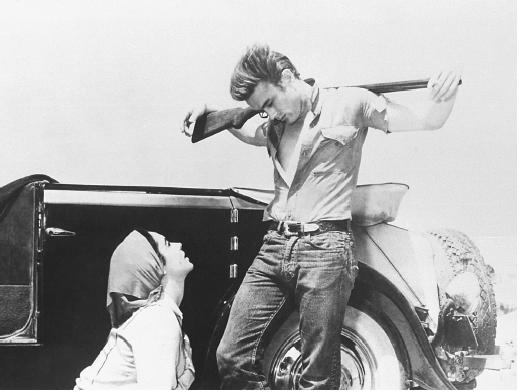
One of JD's goals as an actor was to make a Western, a 
hope fulfilled in George Stevens's Giant.


But perhaps this was all part of his plan. In any event, it had no impact on the public's worship. Whatever his sexual nature, he was masculine enough to maintain male respect and adulation, and sensitive and beautiful enough to continue making young girls swoon. His image, the James Dean he created in life and left behind in death, was part truth and part illusion. He tested his audiences in his private life as much as he did on the screen. His crazy shenanigans-- pulling his shirt over his head while he was eating to detract/attract attention, or his casually strolling into a stranger's home to help himself to a sandwich-- were things that he did consciously and unconsciously. He added to his own mystique, later becoming ensnared by the very enigma he had created. He once turned to a friend after being rude to a studio-head and asked, "If you ever figure out why I just did that, tell me will ya'?" Being his friend was, in fact, a challenge. He pulled stunts to push those closest away, trying to see who would remain faithful no matter what he pulled. To this day, no one can say with any certainty who the Hell James Dean was. He remains as the proverbial tree in the woods-- making even those who knew him best sometimes wonder if he even existed at all.


Dean and mechanic Rolf Weutherich prepare for Dean's last drive 
in "Little Bastard."


In the end, it became too complicated for James Dean to be James Dean. His insatiable love for acting, which took him from Los Angeles to New York and back again, had but one foe for the number one place in his heart: racing. Dean loved to drive. Not only did the speed fulfill his craving for pulsating adrenaline and invigorating stimuli, but it gave him escape. Behind the wheel, he was focused, in control, and away from both the madness of the world and his own uncertainties, insecurities, and emotions. It gave him strength, to defy and conquer danger at once. As in all things he tried, he excelled at driving. Many seasoned racers remarked on his "steel hands" and imperturbable focus, but most importantly his total lack of fear. Ironically, he was safer on the fiery and foreboding dirt paths of the racetrack than he was on the open road. A freak accident in 1955 on route 46 claimed the life of a man that fate alone had the power to kill. Herein do we find the popular slogans: "Live fast, die young" and "Too fast to live, too young to die." Dean would have been irked by this legacy. The youths who look up to him, who seek to emulate him by being "complicated," "dark," and "tortured," those who worship his offspring-- Morrison, Cobain, Phoenix-- by mirroring his tragedy, do not understand his passions. Dean hungered for life not death. While he openly admitted an uncanny premonition that he would not make it to thirty, he also was quoted as saying, (when questioned about his daredevil ways), that he would never purposely endanger his life, because he had too much to live for, too much he had yet to do, too much he wanted to learn. Dean was far from "done," and we were not yet finished with him when he was abruptly taken. Sadly, legends can only be born in death. 


Dean became good friends with photographer Dennis Stock, who took this "silly" photo, 
which would become morbidly popular after Jimmy's death.


The legend lives on in the many faces he left behind: the lost puppy you want to nurture, the fidgety rebel who makes you want to defy, and the beam of irrepressible sex appeal that makes you want to do many, many things.

~ ~ ~

In college, one of my professors told me that the scene in which Sal Mineo looks into his locker mirror in Rebel Without A Cause, and sees James Dean's face reflected back at him, is the most written about moment in cinematic history. I believe it. I believe it, because it is perhaps one of the most honest moments ever captured on film. All of us look onto the movie screen waiting to see little pieces of ourselves reflected back, and we look for them in the most beautiful of Hollywood's faces. Since Dean remains one of our most cherished idols, we to this day still look at him and see ourselves. He exteriorized our true demons and yet delivered his performances with a grace, a swagger, and a charm that we too hoped to possess. He was the man of our dreams and the self of our dreams. In trying to become all human beings, he succeeded only in making us want to be like him. He was just cool. Really, damn cool. Had he survived, there's no telling how much further his talent could have taken himself and us. His career, his human interpretation, his voyage had just begun. Oh Jimmy, Jimmy, Jimmy... Why'd ya do it?


James reveals himself as yet another Christ figure, here with 
Elizabeth Taylor in Giant.


Happy May.

Popular Posts

Total Pageviews