Showing posts with label Gary Cooper. Show all posts

Wednesday, July 20, 2011

NOW, THAT'S FUNNY: Part V

Carole Landis, poised for laughs.


Carole Landis's fun-loving attitude made her an eager participant in many a good-natured joke or game. A warm person, her mere presence seemed to flip the happy switch and put people in a better mood. This came in handy most particularly when she started entertaining the troops during WWII. Her heart went out to the battling soldiers, and she would do anything to give them a little peace and joy in the midst of the chaos that they daily faced. And I mean anything... During the war, radio became a useful outlet for the boys fighting abroad, and a steady stream of broadcasts gave them comforting reminders of home. One particular show, Command Performance, was based upon this concept. It took random requests from the boys and put them into action, making the oddest desires come true. Hopefuls called in with strange petitions, asking for various sound mementos from home or-- more daringly-- celebrity performances. On one interesting occassion, a huge Carole fan asked for very small favor. All he wanted was to listen to her "sigh." Carole must have gotten a good chuckle out of such an odd inquiry, but she gamely agreed to do it. So, on June 14, 1942, Carole stood in front of the microphone and softly proclaimed to soldiers all over the world, "Ahhhhhhhh...." It was a sensation and one of the best remembered moments of the show, as well as one which earned the most requests for replay.


The next jest is too tied to Carole, but there is debate over whether it was she who indeed committed the whimsy or her contemporary Lana Turner (left). In either case, one of these two ladies was again entertaining the soldiers in wartime and dancing with one fellow in particular-- who found his gaze continually traveling downward to the damsel's low-cut neckline. The soldier then humorously asked if the plunging cut was supposed to symbolize "V for Victory?" Not to be outdone, the lady in question quipped back, "Yes, but the bundles aren't for Britain!" Carole would later attribute the punchline to Lana, but some argued that she had in fact said it herself. I guess we'll never know. Both ladies were certainly capable of that kind of brazenly, silly stunt.


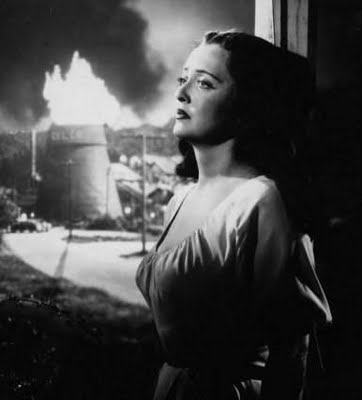
Beyond the Forest is most memorable for being the line in which Bette Davis uttered the eternal quote: "What a dump." However, there is actually a rather funny story involving another quote from the film. See, Bette didn't want to do the film in the first place. She thought both the story and the character were beneath her. Having constantly battled with studio head Jack Warner in the past, her fierce, stubborn streak was old news at this point. It was clear that both Bette and Warner Brothers were growing tired of each other. She fought, begged, and pleaded to get out of the role, even offering up casting suggestions-- she thought Virginia Mayo was better suited to play Rosa Moline, which was probably a back-handed compliment at the actress, who was more notorious for playing sexy, gangsters' molls. In the end, Bette's tenacity did not get her out of the movie, but it did end her contract. She threatened to walk off the picture, which was only half finished, thus inducing an ultimatum from Warners: if she finished the picture, she would be free from her home studio. She agreed. Finally, liberated after eighteen years, Bette was ecstatic... Until she learned that she had to return to do some voice over on a badly recorded scene. Glumly, she trudged back to say her last line at WB: "If I don't get out of here, I'll die." (See iconic moment, right).


Gary Cooper (left) was a quiet sort of guy, but that was part of his charm. Where most celebrity males of the time, and in fact today, walked with a confident swagger, he more gracefully strolled. Where many were loud and boastful, throwing their masculine weight around, Gary was quiet and soft spoken. Many a person, particularly women, spent a great deal of time trying to figure out what was going on inside that pretty, silent head of his, and certain gals like Carole Lombard threw up their hands in defeat after trying to figure him out. In the end, Carole preferred the brashness of Gable, thinking Gary was, well, boring. However, this was not so. Coop too had a great sense of fun and naughtiness, as Rita Hayworth and Veronica Lake would witness first hand... when they went on a bender together. This unlikely trio of shy outsiders banded together one fateful night while in Chicago on a War Bond tour. Determined to forget their stresses and throw caution to the wind, they soon found themselves at a strip joint watching the current female attraction on stage.


Gary, despite his bashful demeanor, was one of the notorious Hollywood "ladykillers," so it came as no surprise to Ronni and Rita when a girl plopped down next to him and started a conversation. Gary listened sympathetically, despite being schnockered, as this young woman explained that it was her sister who was dancing on stage and, "Oh dear, isn't it a horrible thing?" Veronica and Rita marvelled at the way Coop was able to draw the unsuspecting girl to him like a moth to a flame; how a complete stranger found herself babbling her innermost sorrows as he at least pretended to listen. He had such a wooing, calming effect. Eventually, having unburdened her conflicted heart, the girl made a drunken exit, leaving her stripping sister and famous cohorts behind, though she was probably not even aware to whom she had just been speaking. Feeling a bit guilty after this revelatory conversation, the three friends quieted their consciences by becoming equally inebriated and ambling down to another strip joint. And just who do you think should be dancing center stage? The very same girl who had just been mourning her sister's sad profession!  As eyes bulged and mouths opened, one can almost imagine Rita and Veronica looking at a surprised Gary and cackling at the twist of fate. The joke, it seemed, was on them! The girl recognized the coterie and humorously gave Gary a great deal of attention, for which he provided a generous tip. As they departed from their night of debauchery, the man of few words had, as usual, little to say. Smirking and shaking his head, he let it go with a: "Well, I'll be damned." (Gary and Rita reunite more soberly during They Came to Cordura).


Vicente Minelli, Judy Garland, and Kate Hepburn chit chat
on the set of Undercurrent.


After the disastrous shoot on Summer Stock, Judy Garland found herself permanently severed from her home studio MGM, which was bittersweet. Happy to be free, yet anxious without a home, her depression was only intensified by her deteriorating marriage to the homosexual Vicente Minelli. At the end of her tether, Judy disappeared into the bathroom and used some broken glass to slash her own throat. This suicide attempt was no laughing matter, of course, but it was typical of Judy, whose injuries were far from fatal. Mostly, she was crying for help, attention, and sympathy-- publicly proclaiming herself the victim of MGM's ruthless brutality. The message was received, and Louis B. Mayer, in a panic about what the negative publicity could do to his studio, sent for Hollywood's immovable pillar of strength, Katharine Hepburn, for help. She agreed to go talk to Judy and hopefully coax her out of the black hole into which she'd fallen. Kate arrived at Judy's home and was barraged by photographers, whom she told in no uncertain terms that if they took her picture, they would be punched in the face. Needless to say, the shutters stopped. In her typical, New England drawl, she then burst into Judy's room with a series of reprimands and supportive anecdotes. "Oh deah, you rally are in a bad way, ahn't you?" Kate offered Judy room and board at her place, where the patient could regain her strength and recuperate. Judy, grateful for the offer, was too terrified to accept. "Relaxing" with Kate surely would include swimming, jogging, and various other tough love rejuvenation tactics. Judy preferred to mope and enjoy the pitiful windfall of sympathy. Yet, Judy loved and respected Kate and felt truly victorious that one of Hollywood's biggest angels had been sent to help her. However, she was soon offered another consoling shoulder, which she did not find as appealing. During prayer at church, Jane Russell believed that she had been sent a divine message to reach out to Judy in her plight. So, she made a telephone call. Judy answered, at which point Jane went into Psalm 23: "The Lord is my shepherd..." Judy, who-- despite evidence to the contrary-- was in no mood to face her maker, quickly and embarrassingly interrupted with a "Thank you" and abruptly hung up. Perhaps at her next prayer session Jane offered up an "Our Father, return to sender."

Talk about "V for Victory..." Jane in her Sunday best.

Tuesday, June 28, 2011

DIDJA KNOW: Part I

The latest addition to the L.A. La Land blog is the article category "Didja Know?" This quick-takes column of cinema trivia will hopefully introduce little known facts and miscellaneous brain food for the ever-hungry, movie-savvy devotee. Dig in!


Didja know, on this famous "I Love Lucy" episode, the co-worker Lucy is left 
alone to work with was an actual candy maker, cast by Desi. In the scene, the
 focused, yet inexperienced, bit player was not acting when she slapped Lucy. 
She really let her have it, and left Lucy seeing stars 
(with chocolate running down her face).

TV Loves Desi:
Though the success of "I Love Lucy" is accurately credited to the zany performance of Lucille Ball, her paramour and partner Desi Arnaz had a great deal to do with the show's popularity, as well as some new innovations that he introduced, not only to "I Love Lucy," but to television in general. Firstly, CBS insisted that the show be filmed before a live audience-- which in itself was a first for a sitcom. Consequently, the now familiar cue cards were invented for the audience: "APPLAUSE," CHEERS", and "LAUGHTER." However, it was quickly noted that the 'LAUGHTER' card was unnecessary. The audience guffawed ably enough on their own thanks to the comedic sensibilities of the entire cast: Lucy, Desi, William Frawley, and Vivian Vance. Desi added his two cents to this novel idea by stipulating that each episode be filmed with three cameras filming simultaneously, thus cutting down on shooting time. It was not an easy sell, but with Karl Freund's photography, it worked so efficiently that the three camera setup became a staple of the televised situation comedy. Another added piece that Desi contributed related to the commercials. After watching the first season's episodes, he concluded that the transition between the show and the advertisements was too awkward. Thus, he contrived to have an animated segue added before each commercial break to inform the viewer of the brief intermissions. So, one now sees in re-runs the cartoon versions of Lucy and Desi smooching at the drive-in or playing with the camera before the interruption of the latest miracle toothpaste, cleaning fluid, or (at the time) cigarette brand.


Rasputin and the Jury:
Ever wonder where those annoying disclaimers in the opening credits come from? You know, the ones that say, "Any resemblence to persons alive or dead is complete coincidence..." yadda yadda yadda? Well, we have director Richard Boleslawski's Rasputin and the Empress to thank for that. When the film-- which dramatizes the notorious Grigori Rasputin's relationship with the last Czar (et familia)-- was released in 1934, MGM was sued by Princess Irina Alexandrovna Youssoupoff for libel when she claimed to recognize herself  in the character Princess Natasha. In the film, John Barrymore's character too represents Prince Chegodiefl, who had a direct part in Rasputin's (played by Lionel Barrymore, with John right) murder. It was not this macabre revelation that bothered Chegodiefl and his wife-- he in fact took pride in his part of the assassination; it was the idea that the Princess, or rather her character, was presented in the film as having been seduced by Rasputin, like the many other Russian women of the time. Because of this, the disclaimer was added, and to protect their backsides from future financial attacks, MGM and other studios started adding these shields of dissociation to all films based upon biographical material. Another interesting tidbit about the film is that it is the only time all three Barrymores appeared together onscreen. Though Lionel and John would work together in films like Dinner at Eight and Grand Hotel, Ethel (portraying the Empress in this film) was too attached to the stage to be wooed into too many Hollywood pictures, with her brothers or not.


The "Dirty" Lie:
Since I have been on a bit of a gangster kick lately, I thought I would introduce the following tidbit. Many of us have heard the phrase, "You dirty rat..." which we associate with mobster flicks. Commonly, this derogatory exclamation is attributed to the eternal Movieland hood, James Cagney. However, this credit is undeservedly bestowed, as Cagney himself would attest. The true source of the now iconic utterance is none other than Lon Chaney, whose Black Mike Silva said it, albeit silently, in the 1920 Tod Browning picture Outside the Law (left with Priscilla Dean and Wheeler Oakman). Before Lon became associated with his outlandish makeup concoctions and the macabre and sometimes monstrous performances that would become his token, he popularly played the character heavy and bad guy in a slew of early silent films that explored the dark underbelly of city life. His contribution to the slowly evolving genre of the gangster pic set the groundwork for later cinematic derelicts like Cagney, Robinson, and Raft to tread upon. Other films depicting Lon in a similar vein are The Blackbird, The Wicked Darling, and The Penalty.


Miss Quoted:
Another incorrect quote credit involves Ginger Rogers (right), that saucy lady of steps. Beautiful, graceful, and possessing both acting chops and a biting humor, Ginge' made everything she did look seamless and easy. Obviously, this was not the case. Behind all of her street smart characters and effortless dance moves, opposite Fred Astaire, went a hefty bit of diligence, rehearsal, and training. For this reason, because of the woman she was and the success she was able to accomplish, she was in her time, and still today, a popular feminist icon. It is often recalled that she said: "I did everything Fred Astaire did, but backwards and in high heels!" However, she never made this statement herself. The true source was the popular comic strip created by Bob Thaves, "Frank and Ernest," and in particular the cartoon printed in 1982. Yet, because it bore the ring of truth, the famous quote became one of the continuing slogans for girl power. Whether Ginger said the actual words or not, she did indeed live the example, for which women everywhere remain eternally grateful.


The famous Ginger comic strip.  


City Noise:
In the early days of the talkies, directors were trying to find new and innovative ways to not only record and synchronize sound appropriately, but also use it to a film's best advantage artistically speaking. All of a sudden, in addition to awkward staging to allow recorded dialogue, filmmakers began toying with sound effects, atmospheric sound, audio transitions, etc. It was all a little rocky, which explains why so many silent film players were certain that the latest invention was just another fad. Yet, the transition carried over, and slowly the kinks were ironed out and new ideas perfected. One such example comes via Rouben Mamoulian's City Streets (1931) starring Gary Cooper and Sylvia Sidney (left). Mamoulian is credited through the film of introducing the wonder of the "inner monologue." For the first time, a character's thoughts are heard by the viewer while the character herself remains silent. In this case, Sylvia Sidney ponders worriedly about her lover, Gary Cooper, and she hears his voice in her mind, as does the viewer. This technique was poo-pooed by many at the studio, who thought it came off as ridiculous and would never work, but it became a landmark moment. In the same year, Fritz Lang employed the same practice in his first sound film M, starring Peter Lorre as a twisted, child murderer. At one point in the film, Lorre covers his ears and rocks himself back and forth. The audience hears the whistling of "In the Hall of the Mountain King," which is occuring only inside the psycopath's head, both calming him and firing him up for the kill at the same time. This method was soon copied by others until it became a commonplace staple of cinema narrative. No longer does an audience have to guess what a character is thinking. We can hear it too! (Another interesting bit of info from City Streets is that originally, Gary's former lover Clara Bow was to appear in the picture, but she was replaced by Sylvia after she suffered one of the tragic nervous breaksdowns that would send her career on a downward spiral).

Wednesday, June 8, 2011

HISTORY LESSON: Movie Stars and the Mob


Hollywood's favorite Gangster: James Cagney


There is something intoxicating about the element of danger, isn't there? All of our favorite actors possess it. Who is Brando without it? For that matter, who is Davis without it? Just as different celebrities hypnotize us through their various characters, so too were they mesmerized by a certain breed of the male animal that was even more intoxicating than themselves-- the gangster. Brutal, violent, merciless, not to mention unlawful, the birth of the thug came with the death of alcohol. In protecting human beings by taking away their booze, prohibition ironically unearthed an even more foul, yet even more tempting, villain. Iconically remembered with Tommy guns, cigars, and sometimes baseball bats (thanks to Robert De Niro's turn in The Untouchables), these tough guys emerged from a world of hard knocks and ruthlessness with no other agenda than to make a buck off other men's weaknesses. Businessmen and bruisers, they became rich and powerful through drugs, gambling, white slavery... You name it. Their legacy is a strange and dark mutation of the American dream. Living as the Royalty of the Underworld, it wasn't long before live villains started rubbing elbows with screen heroes. Elbows... and then some.


Why do good girls always want the bad boys? You'd think a lady would know to run far and fast when a man with a more-than-disreputable reputation came into view, yet the opposite effect more popularly occurs. Even some of our most beloved starlets have been hoodwinked by the charms of a devious gangster. Be it the allure of being that close to danger, the attraction of power, the money and spoils the "hood" is able to provide (however his means of obtaining them), certain women have temporarily muted their common sense for a forbidden adrenaline rush. One such lady was Lucille Ball (looking very much the gangster's moll in her role for Dance Girl Dance, left). As a fourteen year-old youngster, her first major boyfriend was a local hood named Johnny DeVita, whose resume included "chauffeuring" for his sketchy father-- aka transporting whiskey. Johnny was tough, which Lucille found a turn-on, and the fact that he carried a gun around made her even more enamored. However, not long after his dad was shot and killed, Johnny would find himself in Jail for his own transgressions. Lucy's taste didn't change much when she became a struggling model in NY. Working for Hattie Carnegie, she often came across gang members looking for good-looking dames to show a swell time. Lucy struck up friendships with many of these fellows, which helped her get a free meal or two, not to mention a false sense of protection. After a neighborhood shootout, she earned the nickname "two-gun." Just why remains a mystery.


Another tough guy Lucy would date and befriend was George Raft. Raft (right) had a lot of mobster ties dating all the way back to his boyhood. He had no ambitions to rise in the ranks of that type of "business," but he ingratiated himself to a number of wise guys who would later call on him for favors when he became a movie star. Mae West would recall meeting Raft for the first time when he was a mere chauffeur for Owney Madden. They had a brief fling, which left Mae reminiscing in later years that George was "all man." Mae, like Lucy, had a taste for the bad boys, but was too smart a business woman to get involved too deeply with them. Emotions remained out of the equation. Strangely, she tried to coerce Raft into appearing in her latest stage production, "Sex," but George had no ambitions toward being an actor either. He had no ambitions at all it seemed, other than to just live as comfortably as possible. It was thus a shock to Mae when, later, George made it to Hollywood before she did and secured a role for her in what would be her film debut: Night After Night. It was a welcome reunion. Despite this, Raft was known by some as hot-tempered and threatening. He still carried around a gun, cozied up to thugs, and had no qualms about slapping someone around. He would even testify on behalf of Bugsy Siegel when the latter was brought up on bookmaking charges. Yet, George seemed to have a soft spot for certain ladies. In addition to Mae, he was helpful to Lucy when he loaned her the money to rent her first bungalow in Hollywood. It was a touching move, for it allowed her to move her entire family from Jamestown to L.A. It would take her more than six years to pay him back, but her pal said that there was no rush.


Pat DiCicco also had mob connections. Publicly an acting agent, privately he was good friends with the likes of Lucky Luciano. Luckily, whatever fling Lucy Ball had with Pat was brief, but Carole Landis was too suckered by his deceptive charms. Initially turned on by his confidence and swagger, she soon found that her Prince Charming had some major rage issues. Their affair would quickly come to an end after a mysterious hospital visit: she was reported to be undergoing cosmetic surgery on her nose, though it is commonly believed that she was repairing the physical damage of a brutal beating. The girl was perfect, after all; she didn't need plastic surgery. Whatever the source of her visit, it marked the end of their relationship. Most notoriously, it was comedienne Thelma Todd who was all too seriously involved with Pat. The two were married in the 1930s (see newlyweds left). Like the others, Thelma fell for what she mistook as Pat's strength, only to find herself constantly on the receiving end of his anger and jealousy. A common error, most women sought these men in hopes of finding protection but put themselves in the line of fire instead... literally. As their marriage was ending, Pat introduced Thelma to Lucky Luciano aka Charles Lucifer, and the two began their own affair. But, as Lucky put the pressure on Thelma to give him space in her Sidewalk Cafe to use as a gambling center, Thelma adamantly refused. Consequently, she was found dead in her garage on December 16, 1935. Though Lucky was certainly the mastermind behind her "accidental" demise, many believed Pat too played an intricate part in ending his ex-wife's life. Since all of Tinsel Town knew this, it makes it strange that any other woman would give Pat a second glance, but in addition to winning over Lucy and Carole, Pat too would tac Joan Blondell, Gloria Vanderbilt, Virginia Bruce, and Elizabeth Taylor onto his roster.


Another infamous Hollywood death that has been tied to in some respect to gang warfare is that of The Black Dahlia, Elizabeth Short. Though many would attest that the macabre nature of her death and the precision with which she was brutally sawed in half suggested the work of a calculating psychopath or serial killer, there were also clues attached to her body that pointed to none other than Bugsy Siegel (right). One theory postulates that newspaper magnate Norman Chandler paid Siegel, along with the aid of a couple of other thugs and a doctor, to kill Bettie after she became pregnant with Norman's child. He feared the threat of a scandal and the tarnishing of his illustrious family's name. If so, this would explain the brutality with which Bettie was beaten across the head and face-- the sadistic Bugsy had a penchant for "pistol whipping." Because her uterus was removed, this too lends to the speculation that her murder was used to cover up an abortion/pregnancy. Also, her body was dumped not far from Bugsy foe Jack Dragna's house, and-- something the police did not let the press in on-- a "D" was carved into her skin, which many attribute to an antagonistic Sicilian "Eff you" from Bugsy to Dragna. With Bugsy's schedule, flying back and forth non-stop while finalizing his precious Flamingo Hotel in Las Vegas, it is possible that he was present to have just enough time to take part in the murder and, knowing him, enjoy it.


Whether or not he did play a role in Bettie's end, Bugsy had a very prominent role in Hollywood-- with both the women and the men. Whatever his sickening and reprehensible behavior in fact, he was able to at least concoct enough fiction to make him fascinating to all of the glitterati. He could be seen on the town at various shindigs, rubbing elbows with Clark Gable and Gary Cooper-- and George Raft, of course. Naturally, the man known as the handsomest thug too partnered up with several actresses, including Marie McDonald and Wendy Barrie. He was also in tight with Jean Harlow's abysmal step-father, Marino Bello, which put him in contact with Jean as well. (Harlow, of course, is also rumored to have had a relationship with Abner "Longie" Zwillman, who helped her secure her first acting contract. He too was said to carry around a locket containing hair from her... uh... nether-regions). Whether these actors truly liked Bugsy or merely tolerated him out of fear is uncertain. One would at least hope that they had their guards up. Most notoriously, Bugsy had a violent and torrential relationship with wannabe actress Virginia "Sugar" Hill (left), who was supposedly just as venomous and abusive as her lover. It would be at Virginia's home in Beverly Hills, 810 N. Linden Drive, where Bugsy would finally meet his maker and face the music for all of his worldly crimes. He was shot clean through the eye. His murder was believed to be payback for all of the money he owed his Flamingo investors.


But all of these names were floating around Hollywood for a reason. The Mob was moving West-- away from the Metropolises of New York and Chicago-- to do big business in show business. Names like Siegel, Luciano, Mickey Cohen, Meyer Lansky, and Frank Nitti are attached to Movieland for very specific reasons. One is now known as "The Great Hollywood Shakedown." Two lesser known names involved are those most responsible for what was to become an enormous extortion racket- Willie Bioff (right) and George Brown. Their scheme started in Chicago, where after dabbling in prostitution, they set their sights on the Stagehands Union. Step one, membership. The slogan was simple: join us you little, underpaid children... or be beaten within an inch of your life. Step Two, after Increasing dues, B&B threatened theater owners with "strikes" if they didn't pay up monthly fees for the use of the union members. Theater owners Sam Katz and Barney Balaban were some of the first hit with the new, raw deal. To keep their theaters running, they played the game, and business continued smoothly. Frank Nitti, Al Capone's heir, soon partnered up (or rather took over), and the venture moved West. Capone had already laid the ground work, and Nitti wanted to finish the job. With the corrupt Buron Fitts running things as the District Attorney in Los Angeles, a complete goon-takeover wouldn't be difficult.


Next, New York's Lucky Luciano (left) was brought into the loop in a temporary or at least feigned truce, and the two branches would work together to take over Tinsel Town. Adding the projectionists' unions and IATSE to the scheme, they could return to men like Balaban, now in Hollywood running Paramount, and demand huge payments to keep their theaters running and their studios filming. The film-businessmen would be forced to pay or suffer the consequences: the loss of their livelihoods or worse, the loss of their lives. All of the major studios were hit: Paramount, Warners, Twentieth-Century, MGM... Game, Set, Match. In a way, it worked for everyone. Under mob control, the studios ran more efficiently than ever, as long as they payed up, and moguls actually saved money paying the bad guys instead of paying the Unions directly. Needless to say, the union members were the ones getting truly and financially screwed. As hot-shot gang members became commonplace at Hollywood parties, corruption whipped into full swing. Producer Joe Schenck even got in on the action via a Dupont Film monopoly, for which he paid ol' Bioff off with a Ranch. The feds caught up with him, however, ironically from a tip from Montgomery Clift, then the SAG President, whose informants alerted the IRS to the fishy financial goings-on. Schenck served five years in prison as a result. By the end of the '40s, with the cat out of the bag, the whole troupe of accomplices was led into court both for participation in the extortion plot and tax evasion. Most would get off due to their connections, but some did not fare as well, including Nitti, who blew his own brains out when the prospect of facing jail time became too daunting. The only one who escaped completely was Lucky, who (after killing Thelma Todd), had left the whole racket, or rather was kicked out by his own partners, to return to New York. He was later deported back to his native Sicily where he would die in 1962 at the ripe old age of 69. One hopes his soul did not fare as well.


Frank Sinatra (right) was the man most notoriously associated with the Mafia in the latter days of Hollywood's golden age. It is common knowledge by now that it was through Old Blue Eyes's influence and mob connections that the Kennedys were able to buy their way into the White House. Of course, after they got what they wanted, the Prez quickly disappeared from Frank's life so that his pristine public image wouldn't be maligned. Frank was... ticked. (There are continuing theories that many members of the mafia, who had connections with the Kennedy family, were outraged by the political family's inability to "do business" properly. While many in America were shocked when JFK was shot dead, those in the underworld were not). Frank often overcompensated for his diminutive stature by surrounding himself by powerful people. His big voice and even bigger ego were all the guy needed, but his need to appear tough and throw his weight around was enhanced by his relationships with gangsters. Sam Giancana and Mickey Cohen were co-owners of Frank's Cal Neva Lodge. Skinny D'Amato was the manager. Frank was also throughout his life associated with Joe and Rocco Fischetti and John Formosa. While this made him somewhat of a moral and political threat, it equally boosted his fan appeal and public image. His male fans particularly were more intrigued when they learned that little Frankie was more than just a singing heartthrob for the ladies. He was a bad-ass mother-f*cker! Say what you will, no one messed with Frank. Well, almost. Frank got a little miffed at Lucille's beloved Desi Arnaz after he started producing "The Untouchables." He felt it was insulting to both Italians and "his friends." Yet, even after he tried to persuade his Cuban comrade to pull the plug, Desi sweet-talked him out of his anger. As Frank himself would say, "I just can't stay mad at the guy."


Edward G. Robinson takes a bullet and makes a hit in Little Caesar.


"The Untouchables" turned out to be a huge hit for Desilu Studios, and one of many Hollywood products that contributed to our understanding of gang warfare. The show would make Robert Stack a star, though his role was that of Det. Eliot Ness (a character reprised by Kevin Kostner in the film version). The show was, however, more about the triumph of good over evil, whereas earlier Hollywood films made in the gangster infiltration hey-day-- specifically those produced during the pre-code era-- had a tendency to glorify the thugs, the goons, and the hoods. It's funny that, aside from Sinatra and Raft, some of the actors most famous for playing these guys were very far from their screen selves. Edward G. Robinson, the infamous pug-faced actor who rose to fame in Little Caesar, was in life an educated aesthete who collected fine art, had a wide knowledge of music and culture, and could speak seven languages fluently. And Cagney, the mad hero of Public Enemy and White Heat? His portrayals of gangsters were convincing, because he observed them while growing up in the Lower East Side of NY. But, while he studied them, he did not assimilate, despite the fact that many of his friends did. He put his passions and angst into his art, becoming a song and dance man instead. His true self would come to the forefront in Yankee Doodle Dandy. Though admitted facades that could never possess the brutality of the real truth, the classic reel tales of booze, violence, and "bidness," are still offers we can't refuse. I guess the flesh and blood (and I do mean blood) realities were just as enticing for some celebs, though dancing with the Devil too often left then burned.

Thursday, May 5, 2011

PERSONAL NOTE: Where Have All the Cowboys Gone?


James Dean represents the salt of the earth and the bitter pill 
of the American struggle in Giant.


I didn't always understand the Western. It seemed too select, too geared toward a certain demographic, too cliched... In the modern day of Political Correctness, watching the token battles of Cowboys vs. Indians seemed a bit silly to say the least. I was never exposed to these films, thus my curiosity and appreciation for the genre remained dormant for several years, while I studied Noir, Musicals, Horror, etc. With a little prodding from Armando Jose Prats, (a man under whom I had the privilege of studying at the good ol' University of KY and author of Invisible Natives: Myth and Identity in the American Western), my eyes were finally opened to the beauties of the Western and its many versions of the American epic. Perhaps more than any other type of cinema, the Western epitomizes, glorifies, and translates the core of Americana, while other branches of the artistic medium are left to merely dissect its mutations. At long last, I "get" the Western, and having been awarded this second sight, I have too suffered a painful repercussion, for I witness in current society a compete dearth of like films. The recent remake of True Grit by the Coen Brothers, which was widely hailed and popularly ignored, and my recent reevaluation of James Dean's last film, Giant, made me start asking questions about this filmic fiasco. As such, pardon the following tangent:


The Western is no longer comprehensible to modern audiences. Why? Because the Western by default investigates and poeticizes the American Frontier. Today, it seems like such a thing doesn't even exist, nor is it fathomable that it ever did. For those of us who came of age in the silver spoon era of the Internet, technology has become our frontier. We adventure and explore realms of megabytes, gigabytes, iPhones, iPads, faster connections, more RAM, etc, etc, etc. Our experience of human evolution is inseparable from the Computer's metamorphosis. I remember my family's first Apple computer. The thing was slow as Hell and black & white. Today, I can watch a living color movie on the Blackberry I hold in my hand. In this era, which is not about land, roads, or even outer space, our final realm of conquest is unseen to the naked eye. We travel on highways of signals and waves. We cannot make a physical pilgrimage across the microchips we depend upon; we travel only mentally. It is because of this that our appreciation of the Western has suffered. (Gary Cooper and Mary Brian in The Virginian, left)


In the filmic terrain of the wild west, land is everything (as in The Massacre, right). Americana, the masculine identity, the establishment of country, and family roots are always dissected. This represents the very establishment of our country: people making a great and daring move to the unknown, staking their claim, and creating a foundation upon which to build a life. Land, the earth, and the eternal struggle of claiming it and building upon it: that was what the West was all about. Sadly, the treatment of the American Indian was rarely portrayed with accuracy-- somehow, when history was brought to life in technicolor, the Native who had been kicked off his land was the bully, and the white man with the steel toe boots was the innocent victim. (This philosophy was later brilliantly mocked in Little Big Man). However, the ideals, if not the facts, remain in tact. Today's civilization does not face the same challenges as the frontiersman. In the beginning, we built up and out, and now that we've hit the roof on physical structure, we're downsizing. 


Strange as it sounds, Tron Legacy (left) is one of the only films that has accurately portrayed this alteration. Tron is a Cyber-Western. Because man can no longer build out literally, so he must build inwardly in the landscapes of cyberspace. An alternate universe and dimension is created in Tron-- a new America produced by Jeff Bridges's very God-like figurehead. A pure people-- natives-- is being wiped out by an invading new breed of computer-generated beings-- foreign invaders-- when a renegade outsider/cowboy saunters into town. He journeys in the name of his father to inherit the burden of the land that he made. He arrives, in the quest of his roots, to better know himself. While there is no dual at dawn with pistols, there is an electronic Circus Maximus battle with Frisbee... thingies. There are no horses, but there are magic wands that turn into motorbikes. This film was, thus, our first adventure into our new mythical, technological frontier. In a surprising sort of way, it represents our generation's Star Wars in that it has opened up a new universe for us to play in. After all, with nowhere else to go on planet earth, the only realm left for expansion seems to be that of imagination.


But does this new mutation possess the same heart and depth of its predecessor, the true American Western? The films that made heroes of John Wayne (right in Stagecoach)Gary Cooper, and Alan Ladd, were not sleek, streamlined, and pumping with adrenaline. They were dirty, gritty, violent, and brimming with an integrity that both survived and was born of these factors. Man and God, God and Country... These were things worth fighting for, which too seems like an insane proposition considering the pagan society we live in presently, where our golden idols of pop stars and green tea smoothies have eclipsed any prospect of a "higher power." If God does exist at all, he cannot exist in this America. The heavy fabric of smog, cell phone signals, and radio waves make it impossible for him to penetrate our world. And besides, we're not looking to the heavens above for guidance when we have Google. In the previously expansive continent of the unknown, America demanded His participation far more. Modern faith interprets the old faith of the Western, thus, with cynicism.

This snobbery is a shame, for Westerns are a reflection of our very nature. The society in which we currently live is unarguably the ancestor of the pioneer society. Before racism was explored in Spike Lee's Do the Right Thing, John Wayne portrayed early American prejudice in The Searchers. Before gang warfare became synonymous with inner-city life, it was graphically detailed in the violent, survivalistic camaraderie of The Wild Bunch (left). While people continue to bicker back and forth about politics-- left wing, right wing, who's right, who's wrong-- they sometimes forget that at one point there were no "wings" at all; that our entire political system, government, and right to a free life was not born in a day. This subject too is showcased in The Man Who Shot Liberty Valance, where structure, order, and bravery overcome lawlessness and subjugation; where man's ability to govern himself and escape oppression reveals itself in the establishment of government.

Giant is a film that reflects all of these qualities. While it is not remembered as the pinnacle Dean film, an honor that belongs to Rebel Without a Cause, it is just as important to our cinematic history and just as indicative of our cultural history. The small town of Marfa, and indeed the whole state of Texas, was not initially keen on the idea of this famous novel being turned into a movie. They felt that Edna Ferber's account of their lifestyle was negative and accusatory. However, director George Stevens used his charm to convey to the locals that he was dedicated to telling their own story, a faithful and true depiction of country life and morality, and not a glamorized Hollywood concoction. His diligent striving for this authenticity is one of the many contributing factors that has allowed Giant to maintain its classic stature. Stevens asked locals to teach his actors how to speak with the proper Texan twang, he used them as advisers on farm life, and many of these small town people served as Extras in the big Hollywood film. Most particularly, the Marfa community embraced James Dean, who probably spent more time with the cowboys, who taught him to ride and lasso, than he did with the rest of his cast. He studied their accents until his original Indiana drawl was drawn out into the bashful and broken Southern dialect of the tragic hero Jett Rink.

The film's themes were universal: racism, interracial romance, honor, wealth, roots, gender roles, family, and above all land. Cowboy and rodeo man Bob Hinkle was proud to refer to his new friend Jimmy (left) as a "good ol' boy," and it was because of his instruction that James so adeptly stole one famous scene from powerhouse actor Rock Hudson: while Jordan Benedict (Rock) tries to outwit Jett (Jimmy) from a piece of land, offering him money instead, Jett barely listens, playing all the while with a piece of rope. He then stands, performs a little trick in which he ties a knot in mid-air, politely refuses the dough, keeps his land, and exits with his now notorious Jett Rink wave. This, to the locals, was Texas: a simple man, building himself up from nothing, who knew that there was more value and dignity in the soil beneath his feet than in all of the money in the world. Of course, the opposing forces of Jett and Jordan are later inverted. After Jett strikes oil, his greed and need for power, his desire to one-up Jordan (the man who had it all: the land, the money, and the woman of his dreams), destroys him, while the older Jordan unlearns his old prejudices, adapts to the changing times, and finds true honor inside himself after he witnesses the fruits of his labor maturing into a different generation of life-- one that he still loves, because it is of his blood.

Another important moment comes from Elizabeth Taylor, who takes one of the first feminist stances in Western cinema history when she defies her own stereotype (right with Rock). From the beginning, her culture and forward-thinking politics combat her new husband Jordan's old-fashioned ways. It is she who enters the ghettos of the Mexican laborers; it is she who talks to her servants as equals. It is she who too stands up against a crowd of smoking men, whose conversation she would like to share. After she is insulted by them, told not to worry her "pretty, little head" about politics, she snaps back. "You mean my pretty, empty head, don't you!?" (Only Bette Davis can match Liz in her bitchy retorts). Liz as Leslie Benedict too represents the eternal mother, one who not only nurtures her children's wishes, even when they digress from old traditions, but embraces Jett and his need to better himself, and indeed envelopes the whole community as it struggles to thrive. Giant, in cinematic history, thus remains a giant, for not only does it explore old American themes, but it expands upon them, breaks them, and translates them to future generations. We recognize the battles of our forefathers while honoring them with change. We evolve, yet maintain our roots.

This is what is lacking today. There are no roots. There is no history. Every day is brand new. Thus, there is no room for the Cowboy. His struggles are forgotten, and his battles of saddle and spur are, in turn, received as visual gibberish. He is as mythic as Zeus on Mt. Olympus. In the old West, the cowboy was God, even when sitting and smoking in his little shack, watching the sun rise and fall, or riding off into the sunset. He had what we do not, which is an America of the earth, not an America at the push of a button. Though the cowboy is the figure that will forever represent the heart of America, he exists today as the mysterious foreigner who does not fit into modern movies. Today, we are concerned with action; yesterday, man was defined by his actions.


Shane (Alan Ladd) has trouble leaving behind little Joey.

 Shane perhaps best epitomizes the last hurrah of the cowboy, with Alan Ladd's Shane riding into town, bringing with him a history of violence, yet an honor and a dignity that shakes up and alters local life. His brief presence forever changes the land he has set foot upon. But, at the end, he must leave. He must bow his head and ride away, for he has nothing more to teach. What is done with the knowledge he has left behind is up to those who remain. He rides off into the distance to new territory, but perhaps more symbolically to Heaven. His disappearance leaves behind a vacancy, a curiosity. Was he a man, or was he a ghost? Whatever the case, he stands as the spirit of America, a land that, like the Lost City of Atlantis, can only be visited in the movies.

Popular Posts

Total Pageviews